First 30 days in the Netherlands: arrival sequence for expats
BRP appointment, BSN, Dutch bank, health insurance, phone, OV-chipkaart, huisarts
Peak season warning (July to September)
- BRP appointment waits hit 4 to 6 weeks in Amsterdam, Utrecht, and Rotterdam during August and September
- Rental market peaks: viewing competition is fiercest in August as students and knowledge migrants arrive together
- Health insurance enrolment must complete within 4 months or face €1.059,48 in CAK fines plus retroactive premiums
Arriving in the Netherlands is a sequence, not a checklist. Each step unlocks the next: your BRP registration unlocks the BSN, the BSN unlocks the Dutch bank account, the bank account unlocks the rental contract, the contract unlocks utility setup. Skip a step and the rest stalls. Most newcomers waste two to three weeks because they tried to open a bank account before getting a BSN, or signed a phone contract before having a Dutch IBAN. This guide gives you the right order and the right timing.
If you have not yet arrived, start with our complete moving to Netherlands guide and the 2026 EES border checklist. If you are choosing a city, see choosing a Dutch city. Already landed? Start at Week 1 below.
Table of contents
Week 1: Arrival and BRP
Address, gemeente appointment, BSN
Week 2: Bank and insurance
Open Dutch IBAN, register health insurance
Week 3: Connectivity
Mobile, internet, OV-chipkaart
Week 4: Settle in
Huisarts, DigiD, energy, taxes
First-month cost breakdown
€4,000-€7,000 itemised
Common mistakes
What stall most arrivals
Skip the first-week grocery puzzle: HelloFresh
Meal kits with English recipe cards delivered weekly. No Albert Heijn decisions, no Dutch label translation, no waste while you sort out BSN, bank and everything else.
Affiliate link. No extra cost to you, keeps our expat guides free.
Your 30-day checklist
Loading your progress...
0% complete. Ticks are saved in your browser.
Week 1
Arrival and BRP registration
Stekkies - Instant WhatsApp/Telegram alerts on new listings across 1,000+ Dutch rental sites.
Set up alertsAffiliate link, no extra cost to you.
Huurwoningen.nl - Respond to landlords without an agency in between. Response counts are shown, so you can judge your odds first.
Browse listingsAffiliate link, no extra cost to you.
Lycamobile - Dutch +31 number without BSN or Dutch bank account. Top up as needed.
Get a Lyca SIMAffiliate link, no extra cost to you.
Week 2
Bank account and health insurance
Wise - EUR IBAN without BSN, real exchange rates. Use as a bridge until your Dutch NL-IBAN is live.
Open WiseAffiliate link, no extra cost to you.
bunq - App-only, €0/mo Free tier, English UI, 90-day BSN grace period.
Open bunqAffiliate link, no extra cost to you.
VinkVink - €142,40/mo. Digital-first subsidiary of Menzis. Chat-only support.
Sign upAffiliate link, no extra cost to you.
Univé - Member-owned, English docs on request, full phone support. Safer if you want a human on the line.
Get a quoteAffiliate link, no extra cost to you.
Week 3
Connectivity: phone, internet, transport
Simpel - From €1/mo on the Odido network for the first 12 months, then from €6,50. Two-year contract.
See plansAffiliate link, no extra cost to you.
Ziggo - Reliable speeds in most urban postcodes, English customer portal.
Check coverageAffiliate link, no extra cost to you.
Youfone Thuis - Budget fibre, no bundled TV. Best pick if you just want internet.
See plansAffiliate link, no extra cost to you.
Superfietsen - City bikes, e-bikes, cargo bikes. Delivered assembled.
Browse bikesAffiliate link, no extra cost to you.
Amazon.nl - A €40 chain + €60 U-lock is the Amsterdam minimum. Two lock types deter theft.
Shop locksAffiliate link, no extra cost to you.
Week 4
Settle in: huisarts, DigiD, energy, taxes
Coolblue Energie - English signup, €300 cashback on 3-year or €100 on 1-year contract.
See offerAffiliate link, no extra cost to you.
First-month cost breakdown (€4,000-€7,000)
The first month is the most expensive because of upfront deposits, furniture, and one-time setup costs. Plan to have at least €4,000 in accessible cash; €7,000 is safer if your rental requires two months of deposit and you arrive unfurnished. Cross-check against our relocation budget guide and cost of living calculator.
| Item | Low | High | Note |
|---|---|---|---|
| Rent (first month) | €900 | €2,400 | Amsterdam high, second-tier low |
| Rent deposit | €900 | €4,800 | 1 to 2 months standard |
| Health insurance | €142 | €185 | 2026 basic premium |
| Phone + internet | €35 | €80 | Postpaid SIM + fibre |
| OV-chipkaart top-up | €30 | €100 | Depends on commute |
| Groceries | €300 | €600 | Albert Heijn, Lidl, Jumbo |
| Bike + 2 locks | €180 | €450 | Used or new entry-level |
| Utilities setup | €150 | €300 | First gas + electric bill |
| Furniture (if unfurnished) | €1,500 | €8,000 | IKEA new vs Marktplaats used |
| Total realistic first month | €4,137 | €16,915 | Furnished + small city = low end |
The 30% ruling, if granted, takes one of the largest bites out of these costs because €5,942/month minimum income drops to roughly €4,159 taxable. See the 30% ruling calculator and housing affordability calculator.
Once you have signed a lease and moved in, add contents insurance and liability cover. Renters use our renters insurance guide (€4-12/mo). Owners and VvE apartment residents should read the home insurance guide for opstal, woonverzekering and eigenaarbelang cover. Also save Dutch emergency numbers in your phone from day one: our emergency numbers hub covers 112, the huisartsenpost, 113 crisis line and Veilig Thuis.
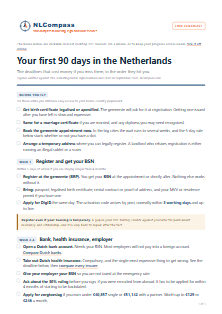
Get the first 90 days checklist
Three pages, free, no card. The deadlines that cost real money if you miss them.
- The 5-day rule for registering with your gemeente
- The 4-month health insurance deadline, and the €529.74 fine behind it
- Every figure checked against IND and Belastingdienst
Common mistakes that stall most arrivals
Trying to open a Dutch bank before getting BSN
Every Dutch bank requires a BSN to comply with anti-money-laundering rules. Open a Wise or Revolut EUR IBAN as a bridge if you need to receive money urgently, then switch to a Dutch NL-IBAN once BSN arrives.
Signing a phone contract before bank account
Postpaid mobile and internet contracts in the Netherlands require SEPA direct debit from a Dutch IBAN. Foreign IBANs are technically allowed under SEPA rules but routinely rejected. Stick to prepaid (Lebara, Lyca) until your Dutch IBAN is live.
Renting on Airbnb-style platforms thinking you can register there
Most short-stay landlords cannot or will not allow BRP registration because they are not licensed for long-term rental. Always confirm in writing before signing. The rental scams guide covers the warning signs.
Delaying health insurance past 4 months
CAK (the government enforcement body) imposes €529,74 fines, stacking to €1.059,48, then auto-enrols you in expensive government insurance. Even with EHIC or private international cover, Dutch law requires basisverzekering.
Missing the 30% ruling 4-month window
If your employer files the 30% ruling application later than 4 months after starting work, you lose the backdated benefit. That can mean €4,000 to €8,000 of net pay in the first year. Push your HR or payroll team in the first weeks.
Frequently asked questions
What should I do in my first week in the Netherlands?
Book your BRP appointment with the gemeente within 5 working days of arrival, secure temporary or permanent housing with a verifiable address, register at the gemeente to receive your BSN, and open a Dutch bank account once your BSN arrives. These four steps unlock everything else: employer payroll, health insurance, phone contracts, and OV-chipkaart use.
How long do I have to register for BSN in the Netherlands?
EU/EEA citizens have 4 months to register at the gemeente, but most banks, employers, and insurers want the BSN immediately. Non-EU citizens with an MVV visa must register within 5 working days of arrival. Book the BRP appointment before flying out, slots in Amsterdam and Utrecht often run 4-6 weeks ahead during August and September peak season.
What is the deadline for Dutch health insurance after arrival?
You must register for Dutch basic health insurance (basisverzekering) within 4 months of becoming a resident. Late registration triggers CAK fines of €529,74 per violation, up to €1.059,48 total, plus retroactive premiums. Even with EHIC or private international cover, Dutch law requires basisverzekering. Premiums in 2026 start at €142,40/month.
Do I need a Dutch bank account or can I use Wise or Revolut?
You will need a Dutch IBAN starting with NL for most employers, the Belastingdienst, energy and internet providers, and DigiD-linked services. Some employers and landlords accept foreign IBANs under SEPA rules but many still reject them. Wise and Revolut offer EUR IBANs (Belgian or Lithuanian) which work for most cases but not all. bunq, ABN AMRO, and ING offer Dutch NL-IBANs.
How much money do I need for my first month in the Netherlands?
Budget €4,000-€7,000 for the first month: €1,500-€2,500 rent including deposit (often 2 months upfront), €142-€185 health insurance, €50-€100 phone contract, €30-€100 OV-chipkaart top-up, €400-€600 groceries, €150-€300 utilities setup, plus furniture if your housing is unfurnished. Knowledge migrants on 30% ruling salaries can absorb this faster.
Can I work in the Netherlands before I receive my BSN?
Yes, you can start working but your employer must withhold income tax at the punitive anoniementarief (anonymous-employee rate) of 52% until you provide a BSN. Once you submit the BSN, payroll corrects retroactively and refunds any overpaid tax. Most employers will not run payroll without a BSN, so request the BRP appointment as early as possible.
Which Dutch city is best for new expats?
Amsterdam offers the largest English-speaking employment market and expat community but rent averages €1,800-€2,400 for one-bedroom apartments. Rotterdam, The Hague, and Utrecht are 25-35% cheaper. Second-tier cities like Eindhoven (tech), Groningen (students), and Leiden (research) trade size for affordability. Choose based on employer location, language needs, and budget.
What is the OV-chipkaart and do I need one immediately?
The OV-chipkaart is the Dutch public transport card used on trains, trams, buses, and metro across the country. Anonymous cards cost €7,50 at NS stations. The Dutch system is mid-transition to OVpay, which lets you tap with a contactless bank card or phone (no card purchase needed) on most operators except NS Intercity for now. Personal OV-chipkaarten (with subscriptions, season tickets, off-peak rates) require a Dutch address and bank account.
How do I find a doctor (huisarts) when I arrive?
Register with a local huisarts (general practitioner) within the first weeks since they coordinate all specialist referrals. Most practices have waiting lists, especially in Amsterdam. Search the Zorgkaart Nederland database, ask your employer relocation team, or check Independer for English-speaking GPs near your postcode. Registration is free for residents. Save Dutch emergency numbers in your phone from day one: 112 for life-threatening emergencies, 0900-8844 for non-urgent police, 113 for crisis support, Veilig Thuis 0800-2000 for domestic violence. Our emergency numbers hub has the full list.
When should I get a Dutch phone number?
Get a Dutch SIM in your first week. Prepaid SIMs (Lebara, Lyca, Vodafone) work without a BSN. Postpaid contracts (Odido, KPN, Youfone, Simpel) need a BSN and Dutch bank account, but are 30-50% cheaper at €10-€25/month. Many services (banks, DigiD, parcel delivery) require a Dutch +31 number for SMS verification.
Looking for more answers? Browse our complete FAQ with 1143 questions across all expat topics.
Continue your Netherlands setup
These guides go deeper on each step above. Bookmark them as you work through the sequence.
BSN registration complete guide
All documents, all cities
Dutch health insurance 2026
€142-185 providers compared
Dutch banking comparison
bunq, ABN AMRO, ING, Rabobank
Housing crisis 2026
What to expect, where to look
30% ruling complete guide
Apply within 4 months
Moving to Netherlands master guide
Pre-arrival to first year