BRP registration & address history Netherlands 2026
From arrival to citizenship (and how to fix gaps)
Quick summary
Your BRP (Basisregistratie Personen) registration and address history form the backbone of your life in the Netherlands. Every interaction with Dutch authorities (from opening a bank account to applying for citizenship) depends on a clean, continuous registration record. This comprehensive guide explains how BRP registration works, why gaps occur, and exactly how to handle registration challenges from your first day in the Netherlands through to permanent residency and naturalisation.
Bottom line: Register within 5 days of arrival, maintain continuous registration throughout your stay, and download your BRP extract annually to catch gaps early. Even a 2-month gap can delay citizenship by 6-12 months. Prevention is everything.
What is the BRP?
The BRP (Basisregistratie Personen, in English the Personal Records Database) is the Dutch government register of everyone who lives in the Netherlands. Your municipality keeps your entry, and government bodies such as the Belastingdienst, the IND and your health insurer read your address from it.
- Who: anyone who will live in the Netherlands for longer than 4 months.
- When: within 5 days of arrival, by appointment at your municipality.
- What you get: your citizen service number (BSN), assigned when you register.
- Shorter stays: under 4 months you register in the separate non-residents register (RNI) instead.
Source: Government.nl, Personal Records Database (BRP), and Netherlands Worldwide, checked 4 October 2026.
Dutch +31 number, no BSN needed
Get a Dutch SIM before you have a BSN
Your gemeente appointment confirmation, DigiD activation code, bank verification, and most rental application replies arrive by SMS to a Dutch +31 number. Lycamobile is the only major provider that signs you up with just a passport. KPN 5G network, English support, eSIM available, activates the day you land.
- Dutch +31 number from day one (no BSN, no Dutch bank)
- Runs on KPN 5G, the best-rated NL network (umlaut 2025)
- 40GB €12.50/mo, held for the full 24 months
- eSIM available, activate before you fly
- Free international calls to 45+ countries
- English customer support
Affiliate link. No extra cost to you, keeps our expat guides free.
Dutch health insurance is mandatory within four months
The four-month clock starts at your BRP registration date. Once you are registered in the BRP you have four months to take out Dutch basic health insurance, and the obligation applies from your registration date rather than from when you sign up. Basic cover is standardised by law, so every insurer sells the same package and price is the main variable.
Compare Dutch health insurersWhy BRP registration matters so much for expats
What is BRP and why it controls everything
The Basisregistratie Personen (BRP), or Personal Records Database, is the Netherlands' central population register. Every person living in the Netherlands for more than 4 months must be registered in the BRP at their actual residential address.
Your BRP registration is the administrative foundation for:
- • BSN (Burgerservicenummer): Your citizen service number for all government interactions
- • Health insurance: Mandatory registration triggers your obligation to obtain insurance within 4 months
- • Tax residency: Belastingdienst uses BRP data to determine tax obligations
- • Toeslagen (benefits): Childcare allowance, rent allowance and healthcare allowance eligibility
- • DigiD: Your digital identity for accessing government services online
- • Banking: Most banks require BRP registration and BSN for account opening
- • Employment contracts: Employers need your BSN for payroll and tax withholding
- • Voting rights: Municipal and water board elections for EU citizens
- • IND residence permit tracking: Immigration service monitors your registered address
BRP vs RNI: Understanding the difference
| Type | Description |
|---|---|
| BRP (residents) | For people living in the Netherlands for 4+ months per year. You have a Dutch residential address and receive full resident status. |
| RNI (non-residents) | For people living in the Netherlands less than 4 months per year, or Dutch citizens living abroad. You receive a BSN but are registered as a non-resident. Only 19 specific municipalities can process RNI registrations. |
Most expats moving to the Netherlands need BRP registration, not RNI.
How BRP history affects long-term status
The IND and municipalities use your BRP history to calculate continuous residence for:
Permanent residency (after 5 years)
Requires uninterrupted legal residence in the Netherlands for 5 consecutive years with valid permits. Your BRP registration serves as primary evidence of continuous presence.
EU long-term residence permit (after 5 years)
Same 5-year continuous residence requirement. This permit allows you to live and work throughout the EU. Absences from the Netherlands cannot exceed 6 months consecutively or 10 months total over the 5-year period.
Dutch citizenship/naturalisation (after 5 years)
Current requirement is 5 consecutive years of legal residence. Parliamentary motions exist to extend this to 10 years, but as of February 2026, 5 years remains the official requirement. Your BRP record must show continuous registered residence.
Critical
A gap in your BRP registration (even one or two months) can reset your residence timeline. You may need to prove continuous presence through alternative documentation (payslips, tax records, health insurance) or wait additional years before applying for permanent status.
Getting registered when you first arrive
Who must register and by when
4-month rule
If you plan to stay in the Netherlands for 4 months or longer, you must register with the municipality where you live.
5-day rule
You are legally required to register within 5 days of arrival in the Netherlands. This includes weekends and public holidays.
Reality check
The 5-day deadline is strict in theory but enforcement varies. However, delaying registration creates practical problems (you cannot get health insurance, open a bank account, or set up utilities without your BSN). Register as soon as physically possible after arrival.
Step-by-step: Your first BRP registration
Step 1: Find housing with registration possibility before arrival
Not all housing allows registration. Before signing any rental contract, explicitly confirm that you can register at the address. Ask landlords: "Can I register with the gemeente at this address? Will you provide the required documents?"
Step 2: Make appointment with municipality (as soon as possible)
Contact your local gemeente immediately upon arrival or even before. Many municipalities have 2-4 week waiting times for registration appointments. You can usually book appointments online or by phone.
Major cities with expat services:
- • Amsterdam: Requires appointment through amsterdam.nl
- • Rotterdam: Book via rotterdam.nl
- • The Hague: Schedule through denhaag.nl
- • Utrecht: Appointments at utrecht.nl
Step 3: Gather required documents
Standard documents needed for first registration:
- • Valid passport or EU/EEA/Swiss national ID card
- • Proof of residence permit or right to reside:
- - Non-EU/EEA/Swiss: Residence endorsement sticker (MVV), temporary residence permit, or IND invitation letter
- - EU/EEA/Swiss citizens: Passport or national ID card (no additional permit needed)
- • Proof of address (one of the following):
- - Signed rental contract (huurcontract)
- - Property deed if you purchased (koopakte)
- - Letter from landlord/owner with copy of their ID
- - Written permission (toestemmingsverklaring) if staying with someone temporarily
Additional documents if applicable:
- • Birth certificate (official with apostille or legalization if from non-EU country)
- • Marriage certificate (if married)
- • Partner's documents if registering together
- • All family members registering together must attend appointment in person
Important: Foreign documents must often be legalized (apostille) and translated by a beëdigd vertaler (sworn translator). Check your municipality's specific requirements.
Step 4: Attend appointment
All family members being registered must attend in person, including babies and children. Bring originals of all documents plus copies if requested.
The municipality employee will:
- • Verify your identity and documents
- • Confirm your address and housing situation
- • Enter your data into the BRP system
- • Issue your BSN (Burgerservicenummer) immediately or within days
Step 5: Receive BSN confirmation
You typically receive your BSN at the appointment or within 1-4 weeks by post. This confirmation letter includes:
- • Your BSN (9-digit number)
- • Your registered address
- • Date of registration
Keep this document safe (you need your BSN for everything in the Netherlands).
Backdating registration to your actual arrival date
✓ You can backdate your registration if:
- • You made your appointment after you arrived in the Netherlands
- • You bring proof of when you made the appointment (email confirmation, screenshot)
- • The appointment must have been made after your actual arrival date
Example:
You arrive January 1st. You book an appointment on January 3rd, but the appointment date is January 25th due to waiting times. Your registration can be backdated to January 3rd (when you made the appointment), not January 25th.
This helps prevent administrative gaps, especially important for residence permit applications and IND requirements.
Registration when you don't have a "perfect" address yet
The catch-22: Need BSN to find housing, need housing to get BSN
Many expats face this dilemma:
- • Landlords require BSN and Dutch bank account for rental applications
- • You need BRP registration to get your BSN
- • You need a rental contract to register in BRP
Solutions exist, but require planning and flexibility.
Hotels, Airbnbs and temporary accommodation
Can you register at a hotel or Airbnb?
Legally, you must register at your actual residence address (where you actually sleep and live). In theory, this could be a hotel if you're genuinely living there for 4+ months.
Reality
Most hotels and Airbnb hosts will not allow registration because:
- • They don't want responsibility for providing required documents
- • Commercial zoning restrictions may prohibit residential registration
- • Landlords fear tax or permit complications
Very rarely, long-term hotel residents or serviced apartments specifically designed for expats may permit registration. Always ask explicitly before booking long-term accommodation.
What this means for you
Don't plan on registering at a hotel/Airbnb unless it's explicitly confirmed in writing by the property owner before you book.
Using a friend's or family member's address temporarily
Is this legal? Yes, with conditions.
If you are genuinely staying at a friend's or family member's address (even temporarily while house-hunting), you can and should register there. You must register where you actually live, not where is most convenient administratively.
Requirements:
- • Written permission from the person registered at that address (the main resident/owner)
- • Copy of their ID (passport or Dutch ID card)
- • Proof they are authorized to grant permission (rental contract showing they live there, or property ownership document)
- • The friend/family member may need to attend the registration appointment with you (varies by municipality)
Important: This is only appropriate if:
- • You are actually living at that address, even temporarily
- • The registered resident genuinely allows you to stay there
- • It's a temporary solution (weeks to 2-3 months) while you find your own place
What happens when you move to your own place:
You simply go to the gemeente and register your new address (verhuizen). This creates a new entry in your BRP, maintaining continuity. There's no gap as long as you register the address change promptly. For the full process, mover costs and timing tips, see our moving within the Netherlands guide.
Correspondence address (briefadres)
A briefadres (correspondence address) is an administrative address where government mail is sent, but you don't live there. This is not a full residential registration.
Who can get a correspondence address:
- • Homeless individuals or people in unstable housing situations
- • People in care institutions, prisons, or shelters
- • People temporarily between addresses (maximum 3 months)
- • People living abroad less than 8 months per year
- • Specific safety situations
How it works:
- • You register the briefadres with your municipality
- • Government correspondence (tax forms, voting cards) is sent there
- • The person or organization providing the briefadres must ensure you receive your mail
- • Cannot be a PO Box or non-residential address
Limitations:
- • Only temporary (typically max 3 months for people between addresses)
- • May complicate health insurance, banking, and some government services
- • Does not meet residence requirements for residence permits that require cohabitation (e.g., partner visas)
Reality for most expats: Briefadres is not a standard solution for new arrivals. It's intended for specific edge cases. Most expats should aim for full residential registration, even if at a temporary address.
Practical strategy for new arrivals without housing
Best approach: Secure registration-eligible temporary housing before arrival
1. Short-term room rental (1-3 months)
Look for short-term rooms explicitly allowing registration. Kamernet, HousingAnywhere, and expat Facebook groups sometimes have these.
2. Register at that temporary address
Even if you know you're moving in 2 months, register there properly. It gives you BSN and starts your legal residence.
3. Search for permanent housing
Now with BSN and Dutch bank account, you're a viable rental candidate.
4. Register address change
When you move to permanent housing, update your registration within 5 days at the gemeente. Your BRP shows continuous residence.
Alternative: Delay arrival until housing secured
If possible, don't move to the Netherlands until you have confirmed housing with registration permission. This avoids stressful first weeks and registration gaps.
Sublets, student rooms and "no registration possible" housing
Why landlords say "no registration"
You'll frequently see rental listings stating "registration not possible" (geen inschrijving mogelijk). Reasons include:
1. Capacity limits
Housing is licensed for a certain number of residents. Landlord already has maximum registrations.
2. Tax implications
Registration can trigger different tax treatment (e.g., for investors) or affect mortgage terms.
3. Illegal subletting
Person renting to you doesn't have permission from the actual landlord/housing corporation to sublet.
4. Social housing restrictions
Some social housing has rules against subletting or registering non-family members.
5. Property type
Commercial property or garage converted to housing without proper permits.
Is "no registration" legal?
For the tenant (you)
You have a legal obligation to register at the address where you actually live. Living somewhere but being registered elsewhere (or not registered at all) violates Dutch law. Penalties can be €325 or higher.
For the landlord
Refusing registration when legally required can result in substantial fines. However, enforcement is inconsistent.
What actually happens if you don't register?
Short-term (first few months):
- • No immediate consequences if you're "under the radar"
- • Cannot get health insurance (legally required within 4 months)
- • Cannot access most government services
- • Banking, employment may be difficult or impossible
Medium-term (3-12 months):
- • CAK (healthcare administrator) may contact you about insurance obligation
- • Belastingdienst may investigate your tax situation
- • Risk of fines for non-registration
- • Building credit history and residence time for PR/citizenship is impossible
Long-term (1+ years):
- • Residence gap: If you later apply for permanent residency or citizenship, this period may not count toward the required 5 years
- • If others try to register at your "fake" or old address, municipality investigates (adresonderzoek)
- • If investigation finds you're not living at registered address, you're marked as "departed, address unknown" (vertrokken, onbekend waarheen), which terminates your residence continuity
How to verify registration is possible
Before signing any lease:
- 1.
Ask directly
"Can I register at this address with the gemeente?" Get written confirmation.
- 2.
Check rental contract
Legitimate landlords include registration permission in contracts.
- 3.
Call the gemeente
Some municipalities can check if an address has capacity for additional registrations.
- 4.
Check address capacity
Ask landlord how many people are currently registered. If it's a small apartment with 8+ registered residents, registration may be impossible.
- 5.
Request proof
Ask to see landlord's registration confirmation or property ownership documents.
Red flags suggesting registration problems
- • "Registration not possible" explicitly stated
- • Landlord evades registration questions
- • Rent is suspiciously cheap
- • Landlord wants all cash payments
- • Contract is vague or minimal
- • Property is listed as "studio" but has 6+ residents
What to do if you're living somewhere without registration
Best option: Move to registration-eligible housing
This is the only guaranteed solution. Continuing to live unregistered risks your entire future in the Netherlands.
Alternative: Negotiate with landlord
Sometimes landlords say "no registration" out of habit, tax concerns, or misunderstanding the law. Explain your legal obligation and that you'll leave if you cannot register. Some landlords relent, especially if:
- • You can show registration is legally allowed at that address
- • You offer to resolve specific landlord concerns (e.g., proof you're not accessing social housing benefits)
Temporary: Register elsewhere while living here
Some people register at a friend's address while actually living elsewhere. This is technically illegal (you must register where you actually live), but enforcement is inconsistent. Risks:
- • Municipality adresonderzoek investigation may discover fraud
- • You're marked as living at wrong address, possibly "departed unknown whereabouts"
- • Criminal penalties for housing fraud (woonfraude) in extreme cases
- • Complications with residence permits requiring actual residence proof
We cannot recommend violating the law, but understanding the reality: many expats do this temporarily while house-hunting. The legal obligation is clear: register where you actually live.
BRP registration, visas and partner/family permits
Why same-address registration matters for partner visas
Many residence permits require the sponsor and applicant to live together and be registered at the same address in the BRP:
- • Partner visa / family reunification (both married and unmarried partners)
- • Spouse of Dutch national
- • Child joining parent in Netherlands
- • Dependent family members of HSM workers
IND requirement
Both partners must register at the same residential address. Your residence permit may state "This document is only valid if the holder is registered at the sponsor's address."
Why this matters:
- • Municipality won't register your partner or issue them a BSN without meeting the requirement
- • Without BSN and proper registration, partner's residence permit is invalid
- • IND can refuse or revoke permits if same-address requirement isn't met
Council of State ruling: Same address not strictly required
Recent legal developments have created nuance:
A 2021 Council of State ruling determined that requiring partners to live at the exact same address can violate EU Directive 2003/86/EC on family reunification. The court stated that partners may have legitimate reasons to maintain separate addresses (work, study, temporary circumstances) while still being in a genuine relationship.
Practical reality
IND still prefers and expects same-address registration. If you and your partner register at different addresses, IND will likely:
- • Question the genuineness of your relationship
- • Request extensive additional evidence of the relationship
- • Potentially refuse or withdraw the residence permit
If you need to maintain separate addresses, you must:
- • Explicitly reference the Council of State ruling in your application/appeal
- • Provide substantial evidence of genuine relationship (photos, shared finances, communication records, witness statements)
- • Consider consulting an immigration lawyer
For most couples: It's far simpler to register at the same address, even if one partner maintains a second address for work or other reasons.
Affiliate link. No extra cost to you, keeps our expat guides free.
BRP gaps and long-term consequences (permanent residence & citizenship)
What is a "BRP gap"?
A BRP gap occurs when there's a period during which you were not registered at any address in the Netherlands, or when there's a discontinuity in your BRP record.
Common causes:
- • Moving addresses and not registering at new address promptly
- • Living abroad temporarily without deregistering, then returning
- • Period between residence permit expiry and renewal approval (procedural gap)
- • Landlord or housing situation prevents registration
- • Municipality error or administrative delay
How continuous residence is calculated
When you apply for permanent residency or Dutch citizenship, the municipality and IND verify you've had 5 consecutive years of legal residence (current requirement, though 10-year proposals exist).
Primary verification method: BRP registration history
Officials check:
- • Date of first registration in Netherlands
- • All subsequent addresses
- • Any periods with no registered address
- • Dates of deregistration (if you left Netherlands)
Continuous residence means:
- • Valid residence permit for entire 5-year period
- • Registered at a residential address in the Netherlands throughout
- • Permits extended on time (within 4 weeks after expiry is typically acceptable)
- • Main residence was in the Netherlands (not abroad)
Do gaps always disqualify you?
Not automatically, but they create problems.
Small procedural gaps (residence permit)
If you submitted residence permit renewal before expiry but IND delays processing, creating a "gap" between old permit expiry and new permit start date, this is typically acceptable for EU long-term residence applications. This was clarified by a Council of State ruling.
However: Dutch permanent residency and citizenship
Even procedural gaps can be problematic. IND takes a stricter interpretation.
BRP registration gaps
These are more serious. If your BRP shows a period where you had no registered address, IND may argue you weren't continuously present in the Netherlands.
Real case example: 2-month BRP gap and naturalisation
A Reddit user shared their experience:
Situation:
During COVID, they were stuck outside the Netherlands for 2 months when their lease ended. They couldn't return due to travel restrictions. This created a 2-month gap in their BRP between their old address and new address.
When applying for citizenship:
IND flagged the gap and requested proof of continuous presence in the Netherlands.
Resolution:
The applicant provided:
- • Payslips showing they continued receiving Dutch salary
- • Health insurance payment records
- • Tax records showing Netherlands as primary residence
- • Dutch employer letter confirming remote work agreement during COVID
- • Bank statements showing transactions in both countries
Outcome:
After review and appeal process, citizenship was approved. Municipality added notes to BRP file explaining the COVID situation.
Key lesson:
Gaps are not automatically fatal, but you bear the burden of proving continuous residence through alternative documentation. This delays applications significantly (often 6-12 months extra) and may require legal assistance.
Proving continuous residence despite BRP gaps
If you have a BRP gap but were genuinely continuously present in the Netherlands, gather:
Employment evidence:
- • Payslips for entire period, showing Dutch employer payments
- • Employment contract showing continuous employment
- • Letter from employer confirming you were working in Netherlands during gap period
Financial evidence:
- • Dutch bank statements showing regular Netherlands-based transactions
- • Rent or mortgage payments for Netherlands address
- • Utility bills (electricity, gas, internet) in your name
Insurance and tax evidence:
- • Dutch health insurance records showing continuous coverage and payments
- • Annual tax returns (aangifte) declaring Netherlands residency
- • Evidence of paying Dutch income tax during gap period
Housing evidence:
- • Rental contracts showing you had housing during the gap
- • Temporary housing receipts (hotel, Airbnb) if between permanent addresses
- • Letter from friend/family confirming you stayed with them
Other evidence:
- • Children's school enrollment records
- • Medical records from Dutch healthcare providers
- • Membership records (gym, library, clubs)
- • Delivery receipts for packages to Netherlands address
Process:
- 1. Identify exact gap dates from your BRP extract (request via MijnOverheid)
- 2. Gather as much evidence as possible for those specific dates
- 3. Write detailed explanation letter for municipality
- 4. Submit explanation and evidence when applying for PR/citizenship
- 5. Be prepared for longer processing time and possible appeal process
How to fix BRP problems proactively
Discovering you have a gap: First steps
Step 1: Obtain your complete BRP extract
Request a full BRP extract (Uittreksel BRP) showing your entire registration history:
- • Via MijnOverheid.nl (requires DigiD)
- • At your gemeente in person
- • Request extract showing all previous addresses and dates
Step 2: Identify exact gap dates
Review extract carefully:
- • Note all addresses and registration dates
- • Identify any periods with no registered address
- • Check if dates between addresses match (deregistration at old address should match registration at new address)
Step 3: Gather contemporaneous evidence
For the gap period, immediately collect:
- • Employment records
- • Tax documents
- • Bank statements
- • Insurance records
- • Housing documents (rental contracts, utility bills)
- • Any other proof you were continuously in Netherlands
Step 4: Write detailed explanation
Create a written explanation including:
- • Exact dates of gap
- • Reason gap occurred (housing issues, administrative error, etc.)
- • Evidence of continuous presence in Netherlands
- • Steps you've taken to ensure no future gaps
Talking to municipality: What to ask
Make appointment with gemeente burgerzaken (citizens affairs) department.
Questions to ask:
1. "Can you explain this gap in my BRP record from [date] to [date]?"
Sometimes gaps are administrative errors that municipality can explain
2. "Can notes be added to my file explaining this gap?"
Municipality may attach explanatory notes to your BRP record
3. "What documentation would help support my PR/citizenship application given this gap?"
Get specific guidance on evidence they recommend
4. "Is there any way to correct or clarify this gap in the system?"
While they cannot change historical data, they may be able to add context
5. "Should I contact IND directly about this, or is it only relevant when I apply for PR/citizenship?"
Understand timing and process
What municipality CAN do:
- • Explain what happened
- • Add explanatory notes to your file
- • Advise on documentation needs
- • Provide detailed BRP extract showing exact dates
What municipality CANNOT do:
- • Change historical registration dates
- • Retroactively register you at past addresses
- • Guarantee IND will accept your explanation
Preparing years in advance: Residence file best practices
Don't wait until you're eligible to start preparing. Begin immediately.
Create a personal residence documentation file containing:
Annual documents:
- • BRP extracts (download yearly via MijnOverheid)
- • Annual tax returns (Jaaropgave, aangifte)
- • Year-end bank statements
- • Health insurance confirmation and payment records
- • Employment contracts and salary slips (keep end-of-year jaaropgave)
Housing documents:
- • Every rental contract, with registration permission noted
- • Purchase documents if you buy property
- • Utility bills showing your name and address
- • Address change confirmations from gemeente
Residence permit documents:
- • Copies of all residence permits
- • Renewal applications and approvals
- • Any IND correspondence
- • Work permit documents if applicable
Life documentation:
- • Children's birth certificates and school enrollment (if applicable)
- • Marriage certificate registered in Netherlands (if applicable)
- • Medical records showing continuous Netherlands healthcare
- • Photos and evidence showing life in Netherlands (work events, social activities)
Travel records:
- • Keep record of dates leaving and returning to Netherlands
- • Passport stamps
- • Flight tickets and hotel receipts
- • Work secondment or study abroad documents
Storage:
- • Physical folder with all critical documents
- • Digital backup (scan everything)
- • Cloud storage for redundancy
- • Update yearly
Annual check (every January):
- • Download current BRP extract
- • Verify no gaps appeared
- • File previous year's tax return
- • Scan and save all residence-related documents from previous year
- • Calculate how many years you have toward PR/citizenship eligibility
Key takeaways
BRP registration is not optional. It's the foundation of your entire life in the Netherlands and your path to long-term status. Register correctly from day one, register address changes within 5 days, and maintain continuous registration throughout your time in the Netherlands.
Gaps are serious but not always fatal. If you discover a gap, immediately gather evidence and document your continuous presence. Many gaps can be explained with sufficient documentation, but they significantly delay and complicate applications.
Prevention is everything. Start building your residence documentation file today. Don't wait until you're eligible for PR or citizenship to start organizing. Keep annual BRP extracts, save all housing and employment documents, and track your travel outside the Netherlands.
When in doubt, register. If you're between addresses, register at a temporary address rather than having no registration. Moving your registration frequently is better than having gaps.
Plan ahead for major life events. Buying a house? Moving cities? Getting married? Consider BRP registration implications in advance and maintain continuous registration throughout transitions.
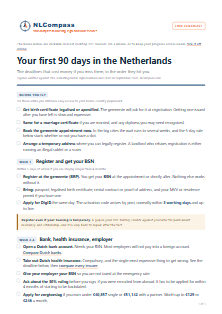
Get the first 90 days checklist
Three pages, free, no card. The deadlines that cost real money if you miss them.
- The 5-day rule for registering with your gemeente
- The 4-month health insurance deadline, and the €529.74 fine behind it
- Every figure checked against IND and Belastingdienst
Official sources
Frequently asked questions
What is the BRP in the Netherlands?
The BRP (Basisregistratie Personen, or Personal Records Database) is the Dutch government register of everyone who lives in the Netherlands, kept by your municipality. If you will live in the Netherlands for longer than 4 months, you must register as a resident within 5 days of arrival, and you receive your citizen service number (BSN) when you register. Shorter stays go in the separate non-residents register (RNI).
Is it legal to live somewhere in the Netherlands without being registered at that address?
No. Dutch law requires you to register at the address where you actually live. Living at one address but being registered at another (or not being registered at all) violates registration law and can result in fines of €325 or more. Additionally, living unregistered creates a gap in your BRP history that can complicate permanent residency and citizenship applications years later.
Will a 2-month BRP gap ruin my chance at Dutch citizenship?
Not necessarily, but it will complicate your application significantly. Many people with short gaps have successfully obtained citizenship by providing comprehensive evidence of continuous presence (employment records, tax returns, bank statements, health insurance records). However, you'll face extended processing times (often 6-12 months extra), may need to appeal, and should consider legal assistance. The key is proving you were genuinely continuously present in the Netherlands despite the administrative gap.
Can I register at a friend's address if I'm between apartments?
Yes, if you're actually living there. You must register at the address where you genuinely reside, even if it's temporary. You need written permission from the person registered at that address, a copy of their ID, and proof they're authorized to host you (their rental contract or property ownership). Some municipalities require the friend to attend the registration appointment with you. This is a legitimate solution while house-hunting, typically for a few weeks to 2-3 months. When you move to your own place, you simply register the address change.
Can my partner get or keep their visa if we're not yet registered at the same address due to housing delays?
This is complicated. IND requires partners to be registered at the same address for most family reunification permits. However, temporary housing delays (such as waiting for a purchase-protection permit) can sometimes be explained with proper documentation. Contact IND directly to explain your situation and provide evidence of the housing timeline and your genuine relationship. In some cases, citing a 2021 Council of State ruling that same-address registration isn't strictly required for genuine relationships can help, but you'll need substantial evidence of your relationship and likely legal assistance.
What happens if my landlord says I can't register at this address?
You're in a difficult position. Dutch law requires you to register where you actually live, but your landlord may have legitimate reasons (capacity limits, tax implications) or illegitimate reasons (illegal sublet) for refusing. Options: 1) Negotiate with landlord to allow registration, 2) Contact the gemeente to verify if registration is possible at that address despite landlord's objection, 3) Move to housing that allows registration (recommended), 4) Register at another address temporarily while living here (technically illegal but enforcement is inconsistent). Long-term, living unregistered risks your permanent residency and citizenship timeline, so finding registration-eligible housing should be a priority.
Can I fix my BRP history retroactively, or do I just have to wait longer before applying for PR/naturalisation?
You cannot change historical BRP entries. Municipalities cannot retroactively register you at past addresses or alter registration dates. What you CAN do: 1) Provide extensive evidence of continuous presence during the gap period, 2) Request municipality to add explanatory notes to your file, 3) Include comprehensive documentation when applying for PR/citizenship. Whether your gap is explainable or resets your 5-year countdown depends on the gap's circumstances and your evidence. Consult an immigration lawyer to assess your specific situation.
How do I check if I have gaps in my BRP registration?
Request a complete BRP extract (Uittreksel BRP) via MijnOverheid.nl (requires DigiD), or visit your gemeente in person. The extract shows all your addresses and registration dates in the Netherlands. Look for any periods where there's no registered address, or where deregistration at one address doesn't match registration at the next address. It's wise to download your BRP extract annually to catch gaps early.
Do I need to deregister when leaving Netherlands temporarily for a few months?
Not if you're leaving for less than 8 months. The 8-month rule requires deregistration if you live outside the Netherlands for more than 8 months within any 12-month period (doesn't have to be consecutive). If you're taking a 3-month trip, studying abroad for 6 months, or have a temporary work assignment for 7 months, you do not deregister - Netherlands remains your registered address. Keep evidence that your absence was temporary (return flight tickets, employer letter, maintained housing).
Does time spent registered as a non-resident (RNI) count toward permanent residency?
Generally, no. Time registered in the RNI (non-residents database) typically does not count toward the 5-year continuous residence requirement for permanent residency or citizenship. You need 5 years of full BRP (resident) registration. The exception is if you were working/studying in the Netherlands regularly while RNI-registered, and can prove Netherlands was your main residence - but this is a complex legal argument requiring evidence and likely legal assistance.
Will short business trips abroad create gaps in my BRP registration?
No. Regular business travel (a few days or weeks at a time) does not affect your BRP registration or residence continuity. You remain registered at your Netherlands address, and short absences are normal. What matters for permanent residency and citizenship is that you don't spend more than 6 consecutive months or 10 months total abroad over the 5-year qualifying period, and that Netherlands remains your main residence (where you sleep most nights, where your family lives, where you work).
What's the difference between Dutch permanent residency and EU long-term residence, and does BRP history affect both equally?
Both require 5 years of continuous legal residence in the Netherlands with valid permits. Dutch permanent residency (Type II) is valid only in the Netherlands. EU long-term residence (Type V) allows you to live and work in other EU countries more easily. Both require clean BRP registration history. However, EU long-term residence has slightly more flexible rules about procedural gaps in residence permits (if you applied on time but IND delayed processing). For BRP registration gaps, both are equally strict - you need continuous registered residence. Most people apply for EU long-term residence because of the added mobility benefit.
Related guides and tools
Explore additional resources for your life in the Netherlands.
BSN registration Amsterdam
Amsterdam-specific BSN registration: appointment booking, student days, required documents, 2026 process.
Family reunification Netherlands
Partner visa guide: 3 pathways, €2,337 income requirement, 6-12 month timeline, work permit delays.
Moving to Netherlands complete guide
Complete relocation guide: visa requirements, housing, BSN, banking, health insurance, culture shock.
Work permits Netherlands
HSM visa requirements, €5,942 salary threshold, 30% ruling, application timeline, employer sponsorship.